

When booking feels seamless, instructors stay engaged, clients stay motivated, and Mecha’s community thrives
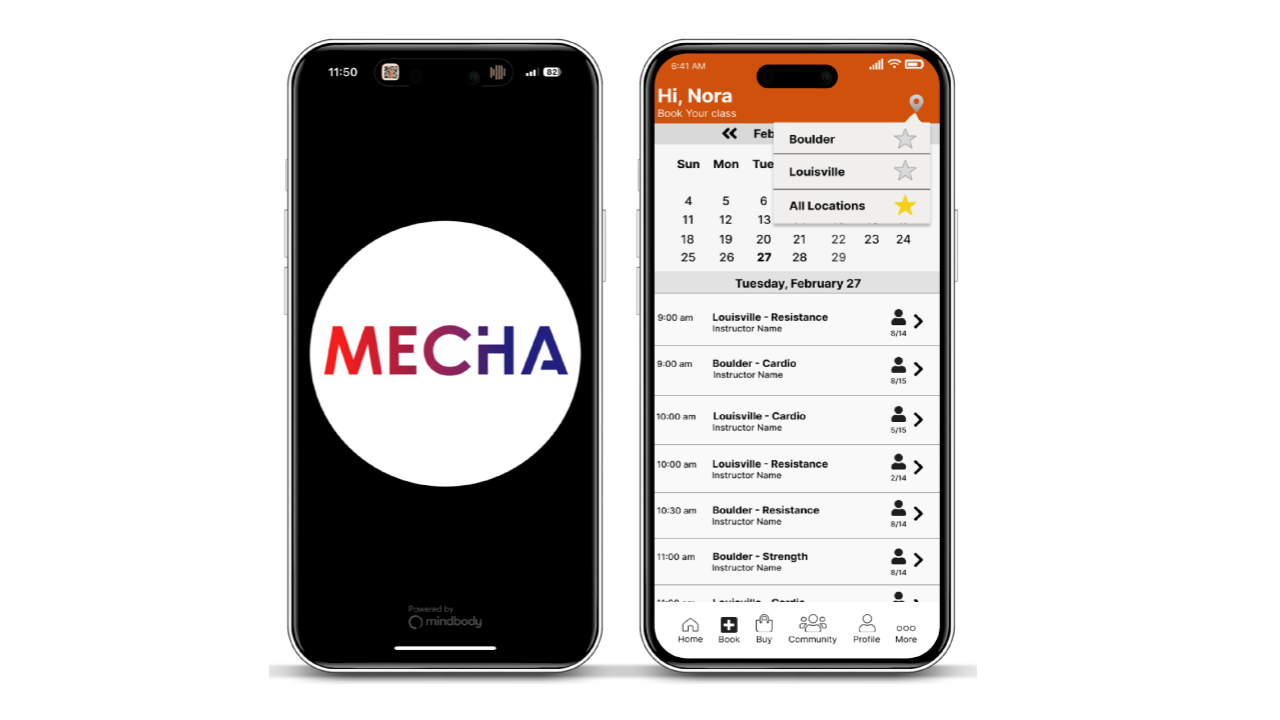
Mecha Fitness App Redesign
Project Context: I led the research and design phase for Mecha's app redesign as part of a UX course project, with full permission from the Studio Manager and signed release forms from all research participants. The prototypes I created informed the final implementation by Mecha's development team, with booking and community features making it into the shipped product.
My role: Lead UX Designer: User Research, Wireframing, Prototyping, Usability Testing
Tools: Figma, Adobe Creative Suite, Notepad
Timeline: 6-Week design sprint
Results:
Reduced instructor turnover by addressing class capacity issues
Increased cross-location bookings through enhanced scheduling
Strengthened community engagement beyond studio walls
Supported business expansion: Mecha opened a third location post-launch
Image Credit Ahmet Kurt Unsplash.com
For fitness instructors, empty spots in class mean more than lost revenue — they threaten livelihoods.
Mecha is a Pilates, Cardio & Strength fitness studio with two locations in Boulder and Louisville, Colorado. Their clients are highly motivated, competitive about booking their favorite classes, and fiercely loyal to the community they've built.
But the booking system was working against everyone.
70% of instructors saw declining class numbers. When clients couldn't see availability across both locations at once, they'd miss opportunities to book. Classes at one studio would be packed while another had empty spots at the same time.
20% of instructors left in six months. Lower class numbers meant lower compensation. For instructors who depend on full classes to make a living, this wasn't sustainable.
30% of client complaints came from misbookings. When clients did switch locations, they'd accidentally register for the wrong studio — leading to frustration, no-shows, and calls to management.
The harder it was to book the right class, the more everyone lost: instructors lost income, clients lost motivation, and Mecha's tight-knit community started to fray.
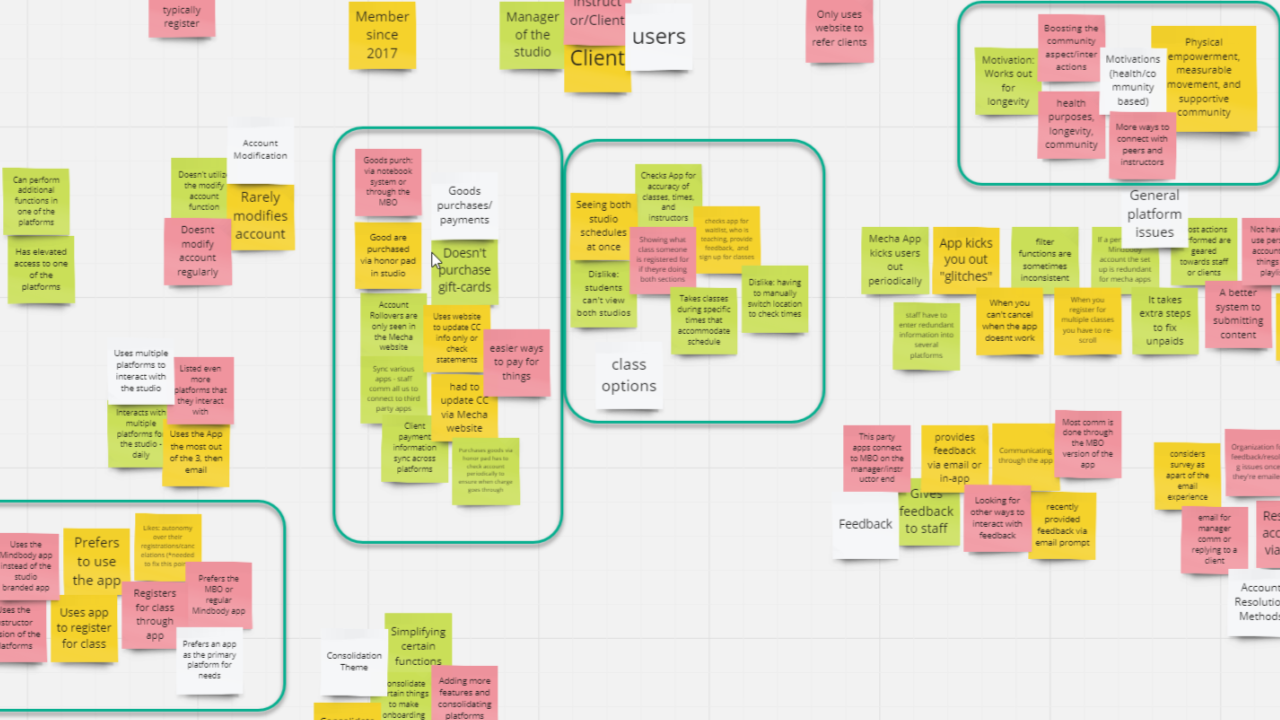
To understand what was really broken, I talked to everyone affected by the booking system.
I interviewed 10 people: clients, instructors, and management. Each group saw the problem differently, but their frustrations pointed to the same root cause: the app made it hard to see the full picture. Clients wanted to attend classes that fit their schedule — regardless of location. But the app forced them to toggle between studios manually, making it easy to miss openings.
Instructors wanted their classes to fill. But when clients couldn't see cross-location availability, spots went unfilled even when motivated people were looking for classes at that exact time.
Management wanted fewer complaints and higher retention. But every misbooking chipped away at client loyalty and created work for the front desk.
The data backed up what people were saying:
95% said ease of booking was their top priority
95% attended for the community — and wanted more ways to connect beyond the studio
85% chose classes based on time slots, not location

Meet Nora: the motivated client caught in a frustrating booking loop.
Nora, 35, is exactly the kind of client Mecha wants to keep. She's committed, attends regularly, and values the friendships she's built in class. Fitness isn't just exercise for her — it's community, accountability, and measurable progress. But booking classes had become a source of friction:
She'd miss opportunities. Nora would search for a 6 AM class at one location, see it was full, and give up — not realizing the other studio had openings at the same time.
She'd misbook classes. When switching locations, she'd accidentally register for the wrong studio, leading to confusion and wasted time fixing it.
She'd lose momentum. When booking felt like a puzzle, it was easier to skip the workout altogether. And for someone who thrives on consistency, that meant losing motivation.
Nora wanted to stay connected to the Mecha community, track her progress, and book classes effortlessly. But the app wasn't built for any of that.
Image source SUNDAY II SUNDAY Unsplash.com
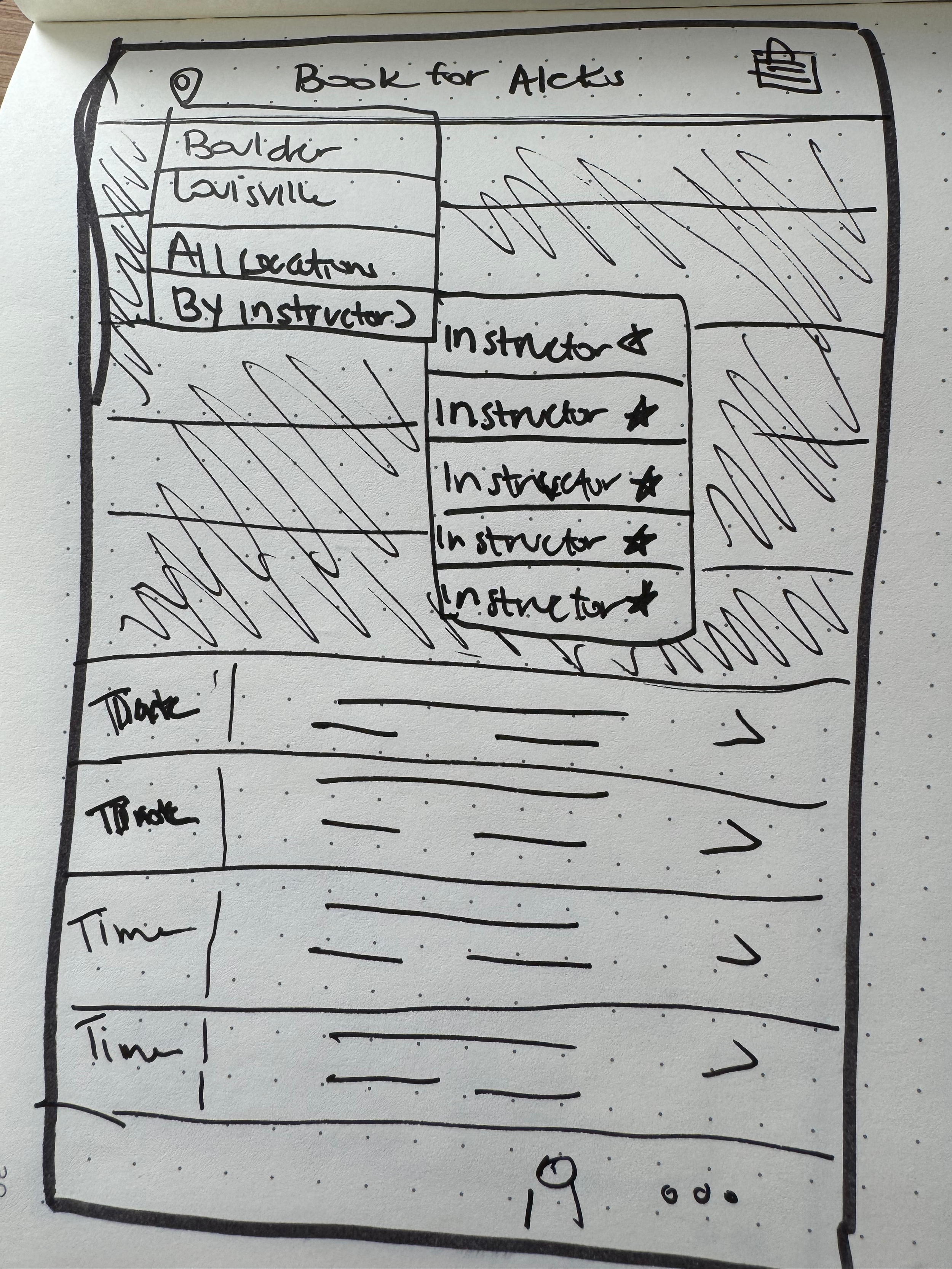
Wireframe
The solution: Focus on what matters most — booking and belonging.
Within a 6-week sprint, I focused the MVP design on the two features that would have the greatest impact on instructor retention and client satisfaction:
Enhanced scheduling — View both locations, filter by teacher, browse with flexible calendar views
Community features — Invite friends, share achievements, discover studio events
These features directly addressed the core pain points revealed in research: clients couldn't find classes across locations (booking), and the strong in-studio community had no digital extension (belonging).
My scope: I led the research, design, and prototyping phases, creating high-fidelity prototypes that were tested with real Mecha clients and staff. Mecha's development team implemented the final product based on these designs and user insights, with the booking enhancements and community features (events tab, invite friends post-booking, social sharing) making it into the shipped product.
FEATURE 1: ENHANCED SCHEDULING
The hardest part of Mecha should be your workout — not finding a class.
The problem: Clients had to toggle between the Boulder and Louisville studios manually, missing opportunities to book classes that fit their schedule. When they found a class, they couldn't easily see their full week of bookings or filter by their favorite instructors.
The insight: 85% of clients chose classes based on time slots, not location. They wanted to see availability across both studios at once, plan their week visually, and follow specific instructors.
The solution I designed: A redesigned scheduling experience with:
Location toggle — Switch between Boulder, Louisville, or view both locations simultaneously to spot openings
Integrated weekly calendar — Jump to the day you want to book instead of endlessly scrolling (added to the app after usability testing enchacing the exaperience)
Monthly calendar view — Plan ahead and browse availability by month
Instructor Filter: Filter classes by favorite instructors (added to the app after usability testing revealed this was a top request)
The impact:
Mecha's development team implemented the scheduling enhancements based on these designs, with the location toggle and calendar views making it into the final product. The teacher filter and week view functionality informed future iterations of the app.
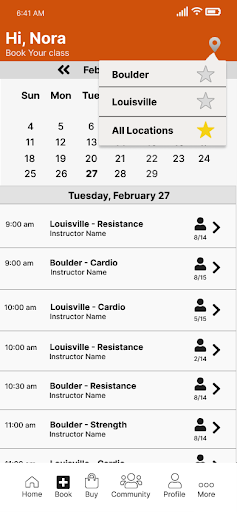
Enhanced Scheduling Prototype
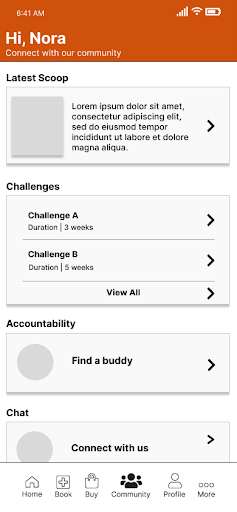
Community Prototype
FEATURE 2: COMMUNITY FEATURES
Fitness motivation doesn't end when you leave the studio — and neither should connections.
The problem: Mecha's community was strong in person but disconnected digitally. Members wanted to connect with friends, share their progress, stay informed about studio events, and participate in challenges — but these actions required leaving the app or relying on Instagram.
The insight: 95% of clients attended for the community aspect. They wanted to grow the Mecha family, celebrate wins publicly, discover what's happening at their preferred location, and stay accountable to fitness goals.
The solution I designed: Community features that extend connections beyond class:
Events tab (location specific): A unified hub showing what's happening at each location: workshops, special classes, studio challenges, and accountability programs
Challenge tracking: Real-time progress on studio challenges (e.g., "500 Springs in a Month") with leaderboards and milestone celebrations
Accountability features: Tools to help members stay committed, find workout buddies, and support each other's goals
What made it into the final implementation: Mecha's development team built the app using Mindbody's platform, which shaped what was technically feasible:
Events tab: Implemented to show location-specific workshops and special classes
Invite friends post-booking: Added because Mindbody's app builder supported this functionality, allowing members to share classes immediately after booking
Social media sharing: Integrated because Mindbody's platform enabled posting achievements to Instagram and Facebook
What was deprioritized due to platform constraints: The Mindbody platform didn't support the challenge tracking and accountability features from the prototype without significant custom development. These features were documented as future enhancements pending platform capabilities or custom development resources.
The impact: While the final implementation differed from the prototype due to platform limitations, the core community goal was achieved: members could now discover events, invite friends, and share their fitness journey — extending the Mecha community beyond studio walls.
Usability testing of the prototypes revealed what worked — and what needed refinement.
After building mid-fidelity prototypes, I tested them with real Mecha clients and staff. Their feedback shaped the final designs that I handed off to Mecha's development team:
Schedule enhancements that tested well:
The location toggle was intuitive and immediately reduced confusion
The calendar view helped clients quickly find dates that worked for their schedule, instead of endless scrolling
Design refinements I made based on testing:
Teacher filter was the #1 request from users** — I added it to the final prototype after hearing repeatedly: "I wish I could filter by my favorite instructor"
Calendar views needed a clearer visual hierarchy to distinguish between booked classes and available slots
Location toggle needed a more prominent indicator showing which view was active (both locations vs. single location)
Community features that resonated:
The unified events tab made it easy to discover everything happening at each studio
Challenge tracking excited members who wanted to see real-time progress
Accountability features resonated with members looking for workout partners
What I learned after implementation: Testing also revealed technical realities: Mecha uses Mindbody's app platform, which influenced what was feasible to implement:
Events tab: Supported by the platform, implemented for location-specific event discovery
Invite friends post-booking: Platform capability allowed this feature to be added
Social media sharing: Built-in Mindbody integration made this straightforward
Challenge tracking and accountability features: Required custom development beyond Mindbody's standard features, documented for future consideration
Teacher filter: Informed future app iterations based on strong user demand
Payment features: Mindbody platform constraints required these to be handled through existing payment flows
This taught me an important lesson: great design must account for technical feasibility. The features that made it into production were those that aligned with both user needs and platform capabilities.
The result: When booking feels seamless, everyone wins.
Based on the prototypes and user research from this project, Mecha's development team implemented the enhanced scheduling and community features.
The impact was significant:
Instructors earn more because classes fill consistently across both locations.
Clients stay motivated because they can find and book the right class without frustration.
Community thrives because members stay connected through the events tab, post-booking invites, and social sharing.
Mecha grows because retention improves, referrals increase, and the experience reinforces what makes them special.
This wasn't just about fixing a booking system. It was about protecting livelihoods, preserving community, and removing barriers between people and their fitness goals.
This project taught me that solving the right problems is more important than solving every problem — and that good design work creates impact even after you hand it off.
My role was to lead the research and design phase: I conducted user interviews, identified pain points, created wireframes and high-fidelity prototypes, and validated designs through usability testing. Mecha's development team then implemented features from the prototype — the location toggle, events tab, and post-booking invite flow all made it into their app.
Seeing my designs solve real problems was validating. Even more rewarding was learning that Mecha recently expanded to a third location (North Boulder), suggesting the redesign supported business growth. When I started, research revealed multiple pain points across two locations: booking friction, disconnected community, and fragmented payments.
In a 6-week sprint, I had to prioritize ruthlessly. The data made the choice clear:
70% of instructors were experiencing capacity issues (booking problem), and 95% of clients attended for the community (engagement problem). These two pain points directly threatened instructors' livelihoods and member retention.
By focusing the prototype on booking and community, I created a research-backed roadmap that Mecha could use to address the crisis — work that started as a class project but became something the studio actually implemented.
The biggest lessons?
Good product design isn't about building everything users want. It's about understanding which problems, if solved, create the most value.
Design must account for technical constraints. The most elegant solution means nothing if the platform can't support it. Learning that Mecha used Mindbody's app builder taught me to validate technical feasibility early, not after designing.
Platform limitations drive prioritization. The features that shipped — events tab, invite friends, social sharing — weren't just good ideas; they were the ideas that aligned with both user needs and platform capabilities.
Student projects can create real impact when they're grounded in genuine research and solve actual problems.
Your work doesn't end when you hand off designs. The insights you uncover and solutions you prototype influence implementation, even when the final product differs from the original vision.
Design impact isn't measured by how many features shipped exactly as designed — it's measured by whether the core problems got solved.
A personal note: This project started as a class assignment, but it became an opportunity to give back to a fitness community I genuinely care about. As both a designer and a Mecha client, I had unique insight into the pain points: I'd experienced the booking frustration, I'd seen instructors struggling with empty classes, and I knew how strong the in-person community was — and how disconnected it felt digitally.
This project showed me that the best work happens when you combine design expertise with personal investment. I got to collaborate with people I train alongside, solve pain points in my own community, and see my design work translate into real features that strengthen the bonds between people who share a common goal. That's the kind of work I want to keep doing.
What’s Next? The redesign worked. Mecha just opened a third location.
When we launched the prototype designs, Mecha had two studios: Boulder and Louisville. The enhanced scheduling and community features addressed critical pain points — instructor turnover, booking frustration, and disconnected community. The implementation by Mecha's team, built on the Mindbody platform, included the location toggle, calendar views, events tab, post-booking invites, and social sharing.
The impact was clear: classes filled more consistently, misbookings dropped, and members stayed engaged. So much so that Mecha recently expanded to North Boulder, bringing their total to three locations. This growth validates what the redesign set out to achieve: when booking feels seamless and community thrives, the business grows.
Features from the prototype awaiting platform capabilities:
Enhanced community features (designed but require custom development) - Challenge tracking with real-time leaderboards and progress visualization - Accountability buddy matching based on schedule preferences and fitness goals - In-app challenge participation and milestone celebrations
Streamlined purchases (deprioritized due to Mindbody constraints) - In-app class package purchasing - Event registration and payment - Scan-to-pay for merchandise
What has been added the most recent iteration:
Teacher filter (high user demand from testing) - Filter classes by favorite instructors across locations - Follow specific instructors and get booking notifications
The foundation is solid. The app now supports cross-location booking, event discovery, and social connection. Future iterations can build on this as Mindbody's platform evolves or custom development resources become available.