

Giving the smallest businesses the tool advice bigger companies already get
Dex: an AI tool-stack advisor for solo businesses · A product management case study
Project Context: Capstone for the eCornell Product Management certificate (July 2026). A concept product I researched, planned, and prototyped end to end. Not launched.
The Problem: Solopreneurs and micro-businesses (1 to 5 people) pick their own software with no trusted guide. Reseller expertise exists, but it shows up after a purchase and is built for bigger deals.
My Role: Product Manager · UX Research · Product Strategy · Prototyping
Tools Used: Figma · Claude · HTML/CSS/JS · Google Docs
What I Delivered:
Five customer discovery sessions synthesized into two personas
A PRD with 15 requirements, a 12-month roadmap, and an AI risk assessment
Phase 1 OKRs, a costed backlog, and a scoped first sprint
A five-screen Figma mockup and a working, clickable prototype
When you're a business of one, every tool decision lands on you.
This project started with calls I used to route. When I worked at an IT reseller and a small business called in, I'd hand them off to inside sales. It made me think resellers just weren't built for businesses that small.
The owner is also the marketer, the bookkeeper, and the IT department. When something breaks or stops scaling, they go looking for a new tool, usually late at night, across a dozen tabs.
And there are a lot of them: nearly 30 million solo businesses in the U.S., about 82% of all small businesses.¹
Every tool says it does everything. Half of them don't talk to each other. And the ones that overpromise cost more than a subscription: they cost the build time, the client's confidence, and the week spent undoing it.
The problem isn't a lack of options. It's the absence of a guide who understands their stack, their stage, and their budget before they commit.
The question I set out to answer: what would it look like to give a 1 to 5 person business the kind of tailored tool advice larger companies get from an account team, for free, before they buy?
Why it matters to a reseller: I saw owners come looking for help, time and time again. Today that help shows up after the purchase. A reseller that earns their trust at the first tool decision becomes the place they come back to as they grow, from one seat to five and beyond. That's revenue that starts earlier and compounds.
Before designing anything, I needed to hear how owners actually choose their tools.
I ran four customer interviews with solopreneurs and micro-business owners: a sales consultant, a consultant and personal trainer, an auto detailing co-owner, and a multi-service founder. The course asked for five, so for the fifth I built a profile from a real ecommerce owner's business details, expanded with AI and confirmed with her afterward. I weighted the four full interviews more heavily.
What I heard:
AI is already where research starts. Almost everyone opened ChatGPT, Gemini, or Claude before anything else
Every tool claims to do everything, and the tools they pick rarely connect
Oversold tools and stalled migrations cost real time and money
"Free" makes people suspicious. Nobody wants to be sold to
Generic AI answers are too broad, and re-explaining your business every time is exhausting
People still want a human option
One owner would switch tools for about 5 hours saved a month, or 10 to 20% lower cost
Two personas came out of it. Diana, the Overqualified Operator, co-owns an ecommerce side business with her husband, who shapes every tool decision. She's vendor-savvy and still gets burned. Marcus, the Reactive Builder, is a solo consultant who loses billable hours every time a tool breaks and pulls him back into research mode.
Then I tested my own assumption. Remember those calls I used to route? Looking closer, small businesses weren't being ignored. They were routed into a sales conversation. Large resellers do have small business teams, but that help is sales-triggered, built around bigger deals, and invisible to the people who need it most. Four of my five owners had never used a reseller. The only one who had works at one.
That reframed Dex. It's not serving an ignored segment. It's making expertise that already exists reachable before the purchase.
Today it's a loop. With Dex, it's a path.
My journey map showed owners cycling: research, trial, then either give up on the tool (sometimes forgetting to cancel the trial) or pick one, hit a problem, and start over. Either way, they end up back at research. Dex moves the guidance to the front, so the loops that remain are deliberate ones..
Before comes from my customer journey map; after comes from the Dex lifecycle flow. The two loops left in the new path are on purpose: refining picks, and coming back when the business needs something new.
The full lifecycle. Here's the after state in detail, mapped across growth, engagement, and monetization:
Every box is something I'd measure, from time to first engagement with Dex to renewal and cancellation rates.
Three decisions shaped Dex more than any feature did.
1. Free, with the business model on the table. People told me "free" makes them suspicious, so Dex explains how it earns in every session: on the landing page, on the recommendations, and in a "How Dex decided" note. The reseller earns when someone buys through it, never on advice. The tradeoff: Dex has to prove its picks aren't margin-driven, which is why every recommendation explains itself using the owner's own answers.
2. The intake conversation is the product. I made the six-question intake the top priority, even though it was the most expensive and riskiest item on the backlog (6 to 10 weeks of engineering). Every downstream goal depends on people finishing it. So launch is gated on a quality bar: a minimum completion and acceptance rate in testing, with a named person who can approve or block release.
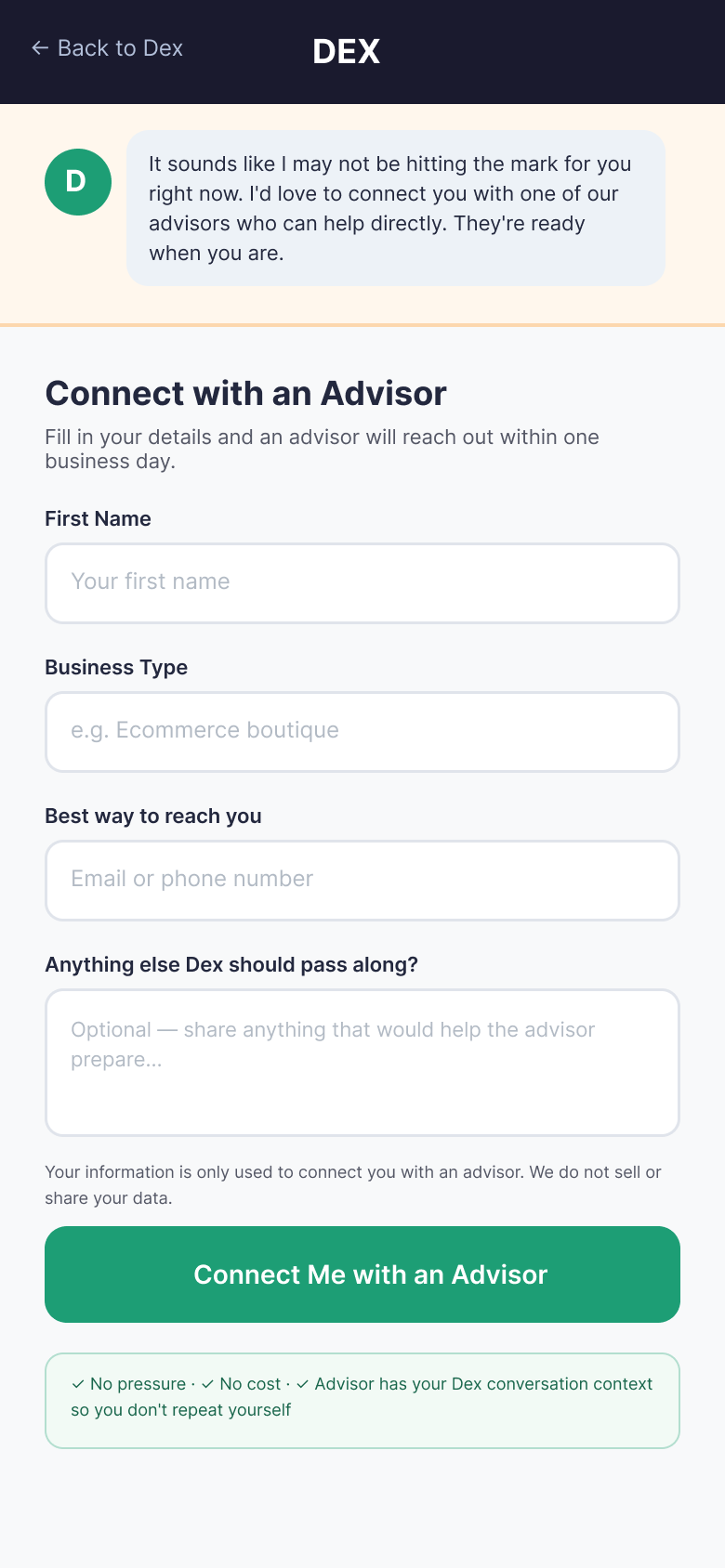
3. A human is always one tap away. Owners wanted a person available, and some worried about AI replacing people. So Dex watches for frustration and offers a warm handoff to a human advisor, who receives the full conversation so nobody repeats themselves. If a recommendation misses, "Reject and Refine" lets the owner say why, in their own words, and get a different set. After two rounds, Dex offers a person instead of looping.
Then I planned it like it was really going to ship.
A 12-month roadmap in three phases. Foundation and launch over the first six months, then engagement and retention, then growth and monetization.
Scoped down to what one team could actually start. I broke the two riskiest epics, the intake engine and Reject and Refine, into role-based tickets for UX, frontend, backend, AI, and QA. Sprint 1 started at 10 points. I cut it to 8 by deferring two tickets as a pair, so no role was left waiting on half a dependency. Phase 1 OKRs, tracked weekly:
Governance built in from day one, not bolted on. I ran a risk assessment against the MIT AI Risk Repository and found four AI risks that mattered most here: biased recommendations, outputs owners can't question, outdated compatibility claims, and low-confidence answers reaching the customer. Each got a mitigation in the plan. Phase 1 resources split 70:20:10: core build, governance, then a bias audit and early scoping for later phases.
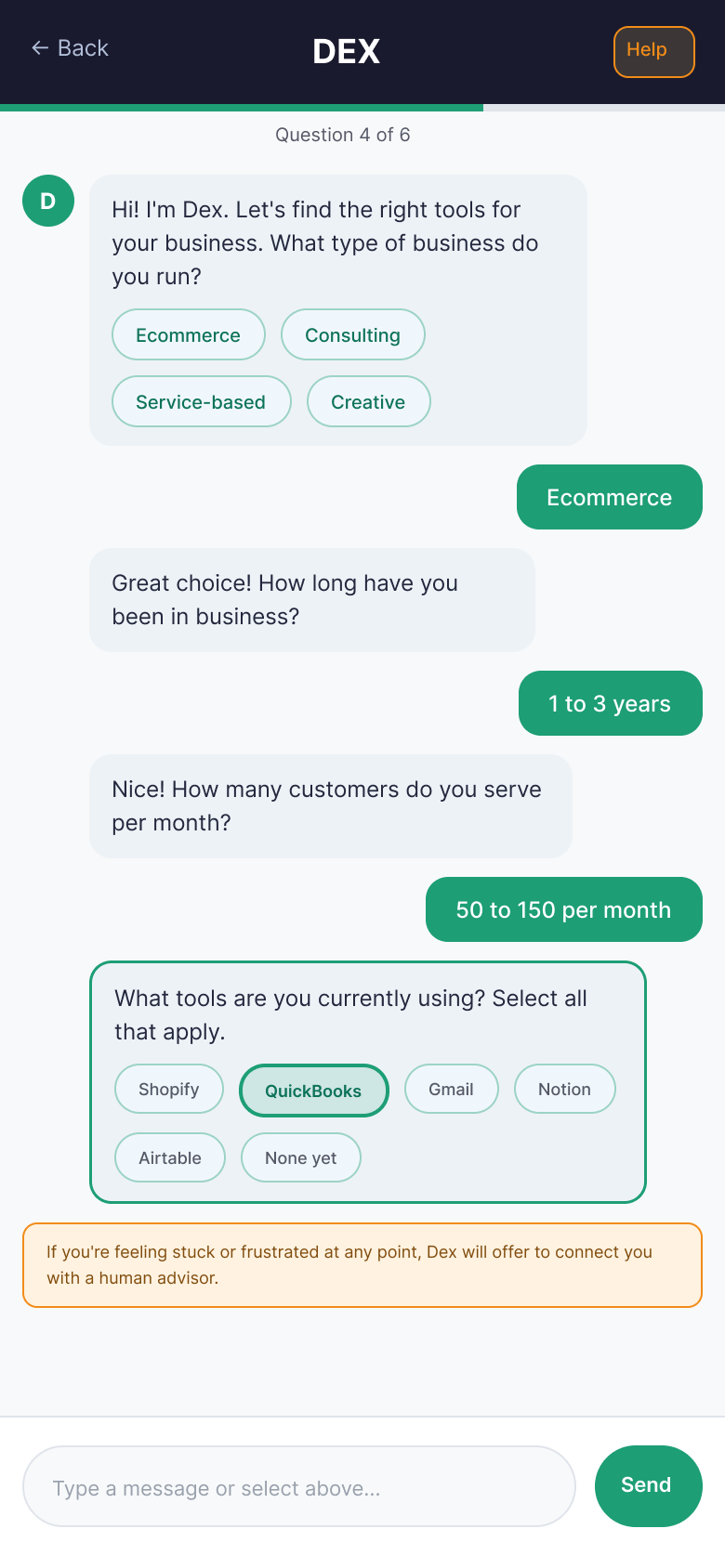
Five screens, one conversation. I designed the flow in Figma, then built a clickable HTML prototype that simulates the conversation, including the frustration handoff and the Reject and Refine loop. The demo follows an ecommerce owner already using QuickBooks.
-
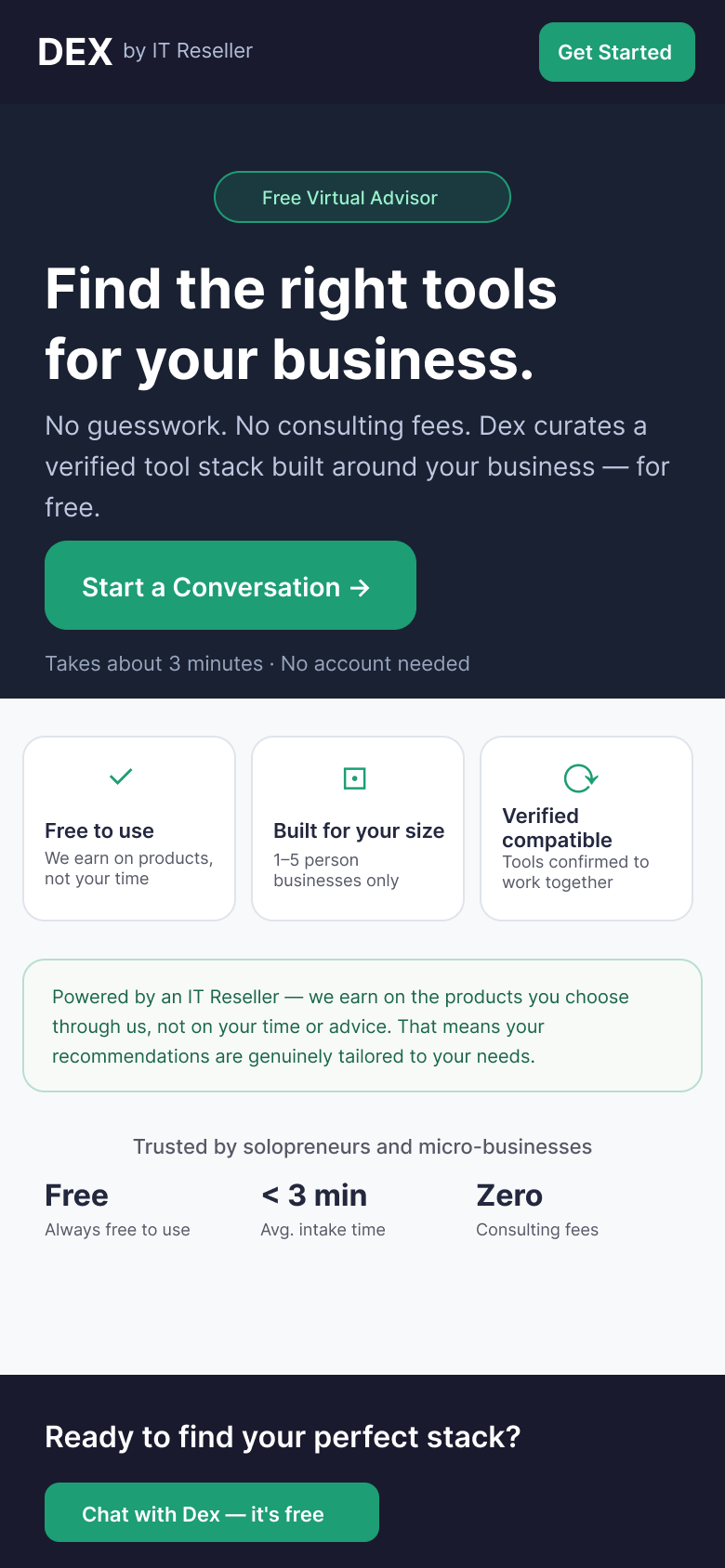
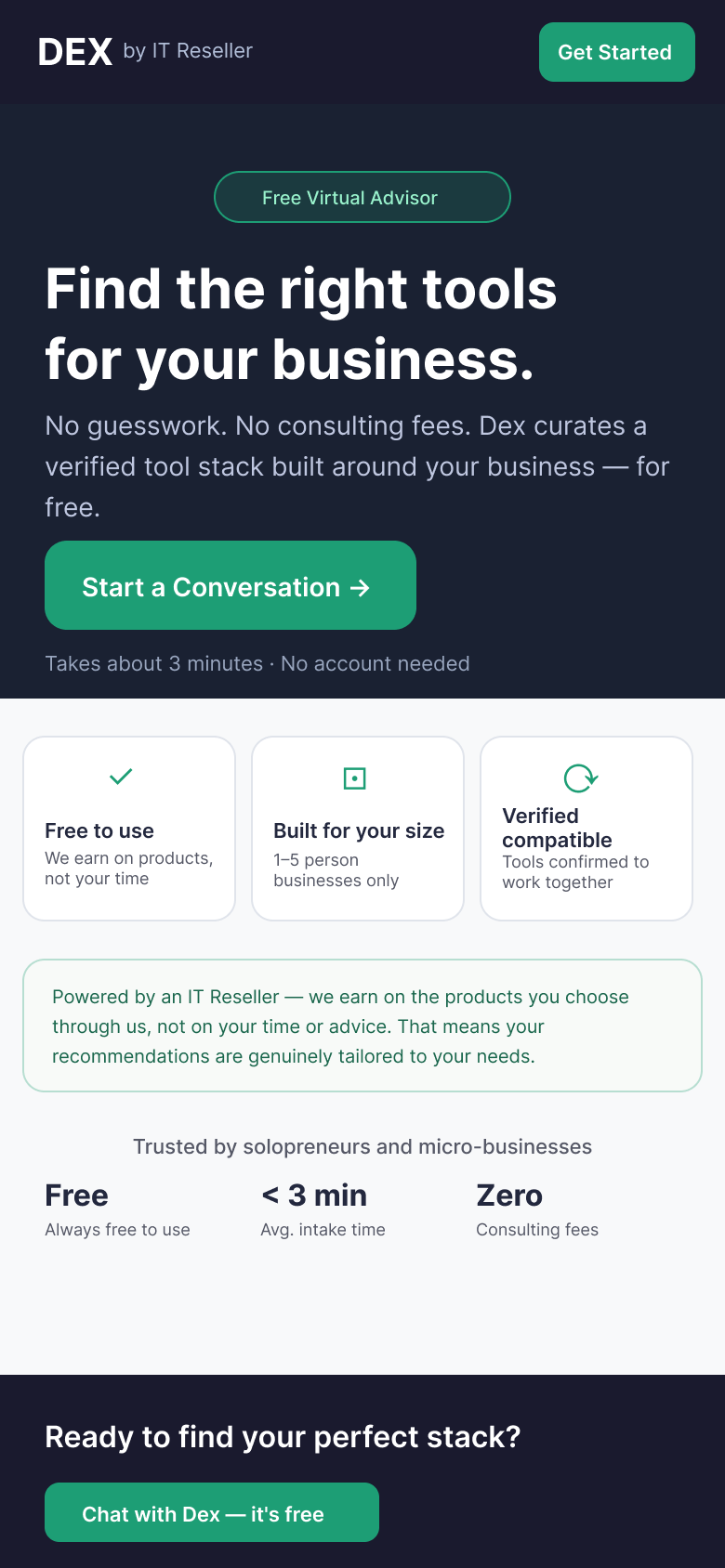
Lead with trust.
Dex is free, built for 1 to 5 person businesses, and says how it earns before anything else. (Concept mockup; the stats shown are illustrative.)
-
Ask before recommending.
Six quick questions, mostly tap-to-answer, with a progress bar and a standing offer of human help.
-
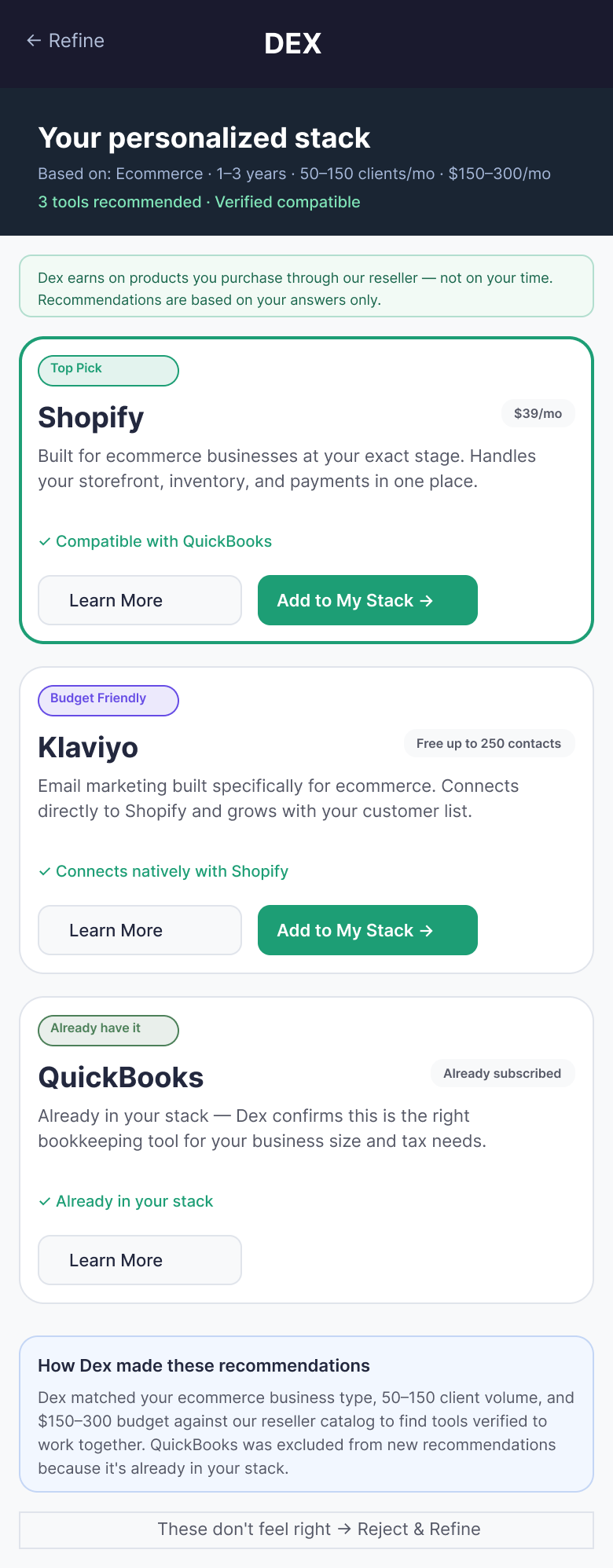
Explain every pick.
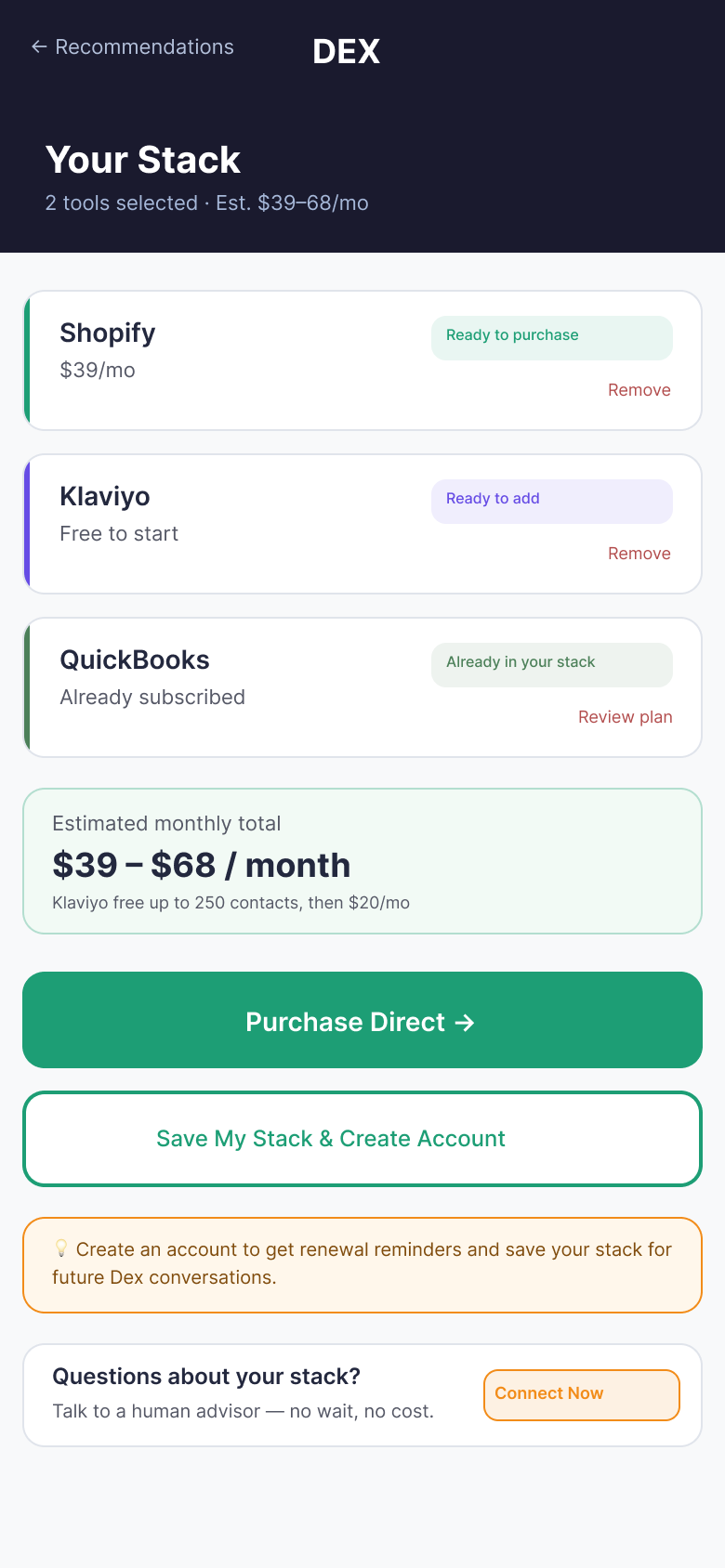
Each tool shows its cost, what it connects to, and why it fits. QuickBooks isn't re-sold, because the owner already has it.
-
Show the real monthly cost.
Including what happens when a free tier runs out, plus a "Review plan" option for tools the owner might want to cancel or switch.
-
Hand off warmly.
The advisor gets the whole conversation, so the owner never starts over.
Dex never launched, so here's how I'd know if it worked.
No results here, and I'd rather say that plainly than invent them. What I can show is how I'd measure it.
One number to watch above all: intake completion. If owners don't trust Dex enough to finish six questions, nothing downstream matters. It's the earliest signal, and it can be fixed before it ever touches revenue.
Early signals vs. proof. Intake completion, time to first engagement, and recommendation acceptance tell me in weeks whether Dex is working. Revenue by channel, renewal rate, and order size tell me months later whether it built trust or just made one sale.
The hypothesis I'd test first: owners who see why a tool was picked, in their own words, accept recommendations more often than owners who see a plain list. If that's wrong, the transparency layer is costing screen space without earning it.
Good product work starts with checking what you think you already know.
The biggest shift in this project came from a question I almost didn't ask: do resellers really ignore small businesses? They don't. Checking that made Dex's purpose sharper, not weaker.
I also learned to be honest about the quality of my evidence. Four full interviews and one expanded profile aren't the same thing, so I didn't treat them the same. And transparency turned out to be a product feature, not a disclaimer. The people I talked to trusted tools that explained themselves.
I scoped Dex to 1 to 5 seats because that's who I interviewed. If this were real, I'd have sized the market first to place that segment, instead of letting the interviews set it. Next time, I'd test whether the same pain holds for businesses with up to 19 employees, the SBA's smallest employer band and about 5.7 million businesses.¹ Starting narrow let me design for real people. Widening is how I'd find out how far the idea travels.
What's next? I'd put the prototype in front of the owners I interviewed, since I promised them early access, and see whether they finish the intake. Then I'd swap the simulated conversation for a real model, with a human reviewing recommendations before they go live (for now). I'd also test the "Review plan" idea, with one honest limit built in: Dex can only cancel what was bought through the reseller. Everything else, it can flag.
Sources
¹ U.S. Small Business Administration, Office of Advocacy, 2025 Small Business Profile: United States, using 2022 Census data: 36.2 million small businesses, 29.8 million with no employees. See also the Advocacy release, June 30, 2025.